


In this blog, you will find:
- What is IoT and why is it strategically important for businesses?
- How does IoT enable predictive maintenance in manufacturing?
- Which other industries are already using IoT, and what results are they seeing?
- How does edge computing reduce latency and bandwidth costs in IoT systems?
- What percentage of enterprises report measurable operational efficiency gains after IoT deployment?
Index:
- What is IoT, and what makes it strategically important?
- How does IoT deliver value when combined with Big Data, AI, Edge, and Cloud?
- Where is IoT already delivering results?
- What should you know before you commit?
- What is the business case for acting now?
- What to prioritize now?
What is IoT, and what makes it strategically important?
The Internet of Things (IoT) is a network of interconnected physical devices, sensors, machines, and software that collect and exchange data over the internet without human intervention. It converts physical operations into real-time, data-driven systems, reducing costs, accelerating decisions, and enabling automation at scale.
Every IoT system runs on six interdependent layers: sensors and actuators, connectivity protocols, data processing and analytics, security controls, cloud computing, and the user interface, where teams act on dashboards, alerts, and voice assistants.
Remove any one of these layers, and the system breaks down. That interdependency is what makes IoT a strategic infrastructure decision, not just a technology purchase.
How does IoT deliver value when combined with Big Data, AI, Edge, and Cloud?
IoT alone is infrastructure. The business value comes from what you connect it to. Four technologies turn a network of devices into a decision-making engine.
Big Data Analytics gives IoT its memory and pattern recognition. IoT generates continuous, high-velocity streams that traditional databases cannot process. Big data platforms ingest from millions of endpoints, find patterns across raw and transformed data, and surface real-time insights. Example: IoT-enabled patient wearables transmit heart rate, glucose, and pulse to physicians in real time, enabling proactive care and supporting drug research.
Artificial Intelligence gives IoT its judgment. For example, machine learning flags equipment anomalies before they become failures. Computer vision automates quality inspection on factory floors. Predictive algorithms cut unplanned downtime in oil, gas, and heavy industry.
Edge Computing gives IoT its speed. Processing data where it is generated eliminates round-trip latency to centralized servers. An autonomous vehicle cannot wait for a cloud response before braking; that decision must happen locally, in milliseconds. Edge also cuts bandwidth costs by filtering data at the source and keeps systems running through connectivity interruptions.
Cloud Computing gives IoT its scale. It scales storage as device fleets grow without upfront capital spend, centralizes management across thousands of endpoints, feeds IoT data into ERP and CRM systems, and eliminates on-premise hardware overhead. Leading enterprise platforms include AWS IoT Core, Microsoft Azure IoT Hub, Google Cloud IoT Core, and IBM Watson IoT.
Where is IoT already delivering results?
IoT is not a roadmap item; it is operational today across every major industry vertical.
- Manufacturing teams use it for predictive maintenance, quality inspection, and inventory control.
- Healthcare runs remote patient monitoring, wearable vital-sign tracking, and connected surgical devices on an IoT infrastructure.
- Transportation and logistics operations deploy it for fleet optimization, cold-chain monitoring, and autonomous routing.
- Energy and utilities teams use it for transmission inspection, leak detection, and smart grid balancing.
- Retail runs shelf management, behavioral analytics, and personalized in-store experiences.
- Smart city programs use it to underpin traffic systems, public safety networks, and utility grids at scale.
Over 60% of smart city initiatives worldwide now involve IoT infrastructure, with more than 63% of government-backed projects integrating it for traffic, energy, and waste management. (Global Growth Insights)
What should you know before you commit?
The case for IoT is strong, but the implementation risks are real.
Advantages
- Over 62% of enterprises report measurable gains in operational efficiency after IoT deployment.
- Predictive intelligence catches failures and demand shifts before they hit operations. Cost reduction flows from lower maintenance, energy, and labor spend.
- Real-time visibility replaces hours-old reporting.
- And at scale, IoT enables new revenue models, data-as-a-service, and outcome-based offerings that were previously out of reach.
The risks are equally concrete
- Cybersecurity concerns affected 36% of IoT deployments in 2026, while 27% faced integration failures across industrial systems. (Business Research Insights).
- Legacy infrastructure almost always requires re-architecture. Over 50% of adopters experience integration friction due to fragmented connectivity standards.
- Many projects stall at the proof-of-concept stage because ROI was not clearly scoped at the outset.
Four actions before you deploy
- Build security into the design rather than adding it after
- Use cloud-based security tools that scale with your device count
- Run a structured proof of concept before full rollout
- Work with an experienced IoT implementation partner to close execution gaps fast.
Turn connected devices into a business advantage.
Our IoT specialists deliver from proof of concept to full-scale deployment.
Talk to a Techwave SpecialistWhat is the business case for acting now?
The market data confirms both the opportunity and the cost of waiting.
- The global IoT market is projected to grow from USD 1,055.02 billion in 2026 to USD 5,552.48 billion by 2034 at a CAGR of 23.10% (Fortune Business Insights).
- The IoT solutions and services segment is valued at USD 400.10 billion in 2026 and is expected to reach USD 1,289.69 billion by 2033, at a CAGR of 18.2% (Coherent Market Insights).
- Industrial IoT stands at USD 214.25 billion in 2026, growing to USD 799.62 billion by 2033 at a CAGR of 20.7% (Coherent Market Insights).
- Connected IoT devices will more than double from 22 billion today to over 40.6 billion by 2034 (Statista).
- 62% of manufacturers have already deployed IoT for predictive maintenance, with 48% reporting direct efficiency gains. (Business Research Insights).
The longer you wait, the more runway your competitors have and the steeper your climb becomes.
What to prioritize now?
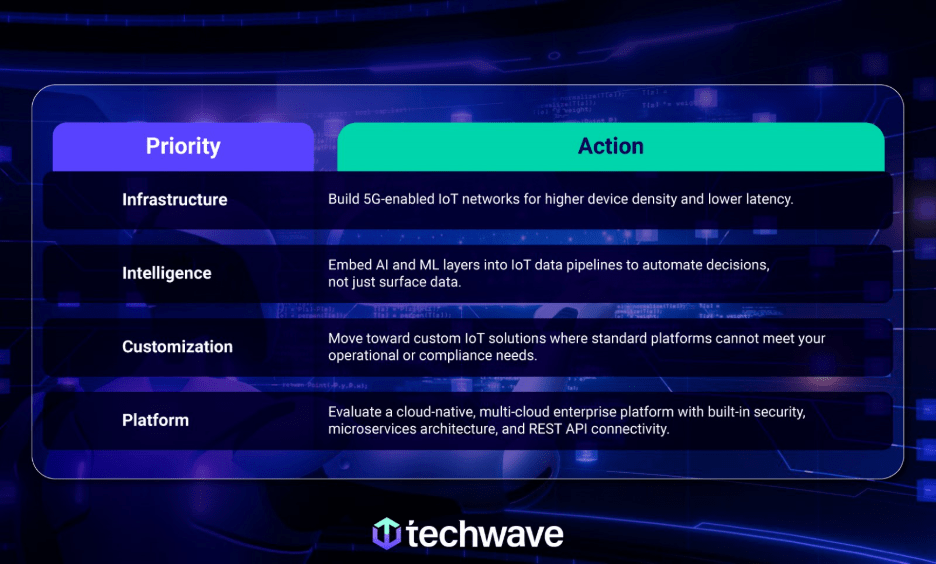
The window for strategic advantage is open, but not indefinitely. Internet of Things combined with AI, also known as Artificial Intelligence of Things (AIoT), Edge, Big Data, and Cloud, is already delivering results. The technology is proven; the rest is execution. Organizations that move with intention, secure their architecture, scope ROI from day one, and partner with proven implementers will compound their advantage over time.

Top 5 Questions Answered in This Blog
- What is IoT and why is it strategically important for businesses?
- How does IoT enable predictive maintenance in manufacturing?
- Which other industries are already using IoT, and what results are they seeing?
- How does edge computing reduce latency and bandwidth costs in IoT systems?
- What percentage of enterprises report measurable operational efficiency gains after IoT deployment?
