

Index:
- What is digital transformation?
- How does digital transformation work?
- What are the core objectives of digital transformation?
- Where is digital transformation already delivering results?
- What is the strategic value, and does digital transformation ever end?
- Where to focus now?
What is digital transformation?
Digital transformation is the integration of digital technology into all areas of a business to fundamentally change how it operates and delivers value to customers. It is not a one-time project; it is a continuous shift from traditional, manual processes to data-driven, automated, and digitally connected operations across every business function.
It encompasses products, employees, operations, customers, competitors, and channels. What makes it strategic rather than merely technical is that it demands a shift in culture and mindset at every level of the organization, not just an upgrade in tools.
How does digital transformation work?
It works by systematically integrating technology across three interconnected layers:
- Strategy & consulting: Assessing current technology, defining goals, and designing a roadmap aligned to business needs and market trends. This is where digital transformation consultants evaluate the current digital state, identify gaps, and determine which technologies (AI, IoT, big data, and/or cloud) will deliver the highest ROI for a specific business context.
- Implementation: Executing the transformation plan through five practices: establishing a strategic path, aligning business goals, adapting execution as conditions evolve, encouraging local innovation, and managing compliance and risk throughout.
- Services & technologies: The actual tools that power transformation: AI, IoT, cloud & edge computing, Robotic Process Automation (RPA), advanced analytics, cybersecurity services, and application modernization. No single technology defines digital transformation; the combination and its application to specific business problems are what drive results.
What are the core objectives of digital transformation?
The core objectives of digital transformation fall into seven measurable categories:
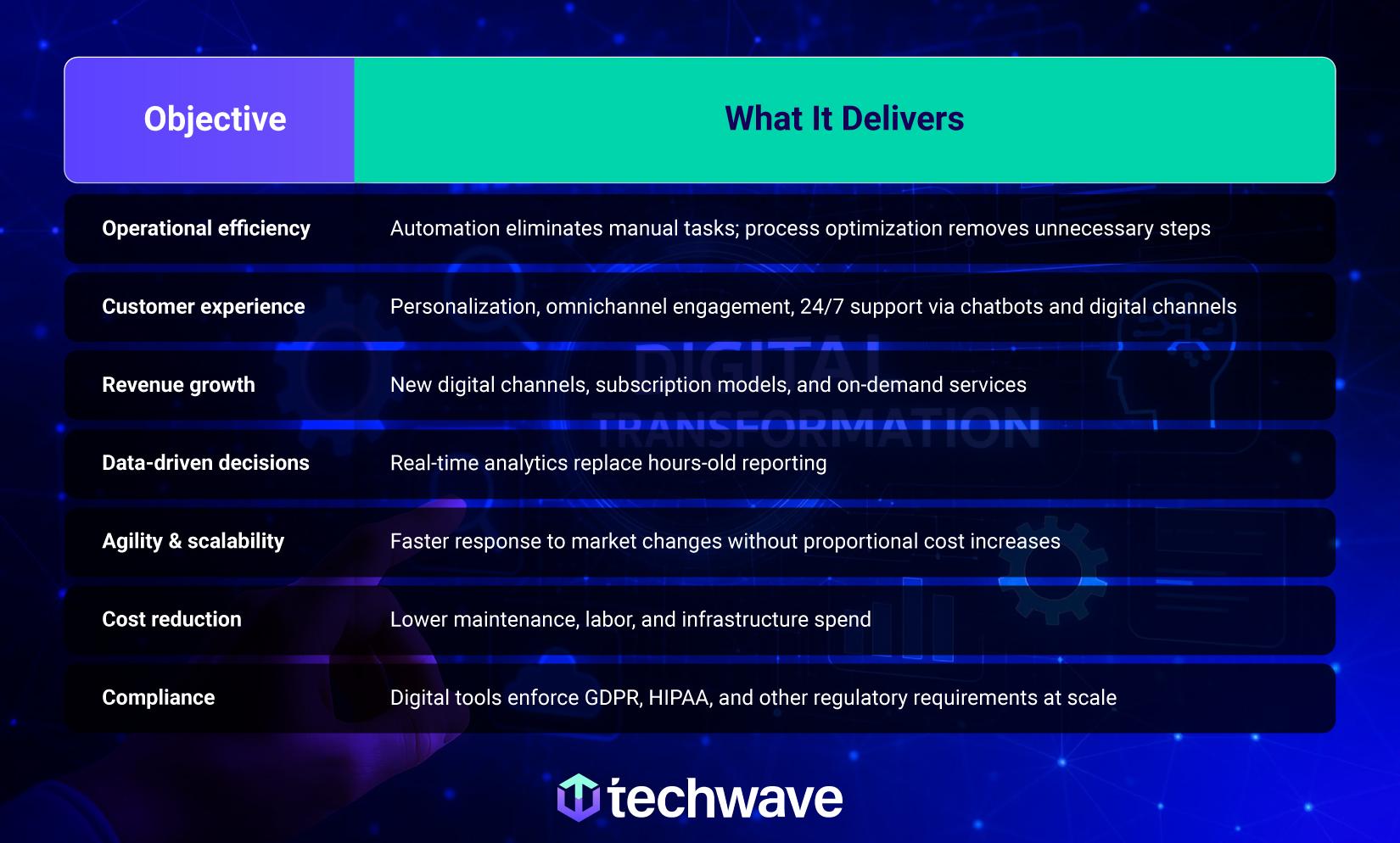
Setting clear, measurable objectives before deployment is the single most important factor separating transformations that deliver ROI from those that stall at proof of concept.
Where is digital transformation already delivering results?
- Banking: Mobile banking, AI chatbots, video KYC, RPA-driven anti-money laundering investigations, and cloud-based omnichannel customer engagement have redefined how financial institutions serve customers. Banks now resolve customer complaints and process transactions at speeds and scales that branch-only models cannot match.
- Manufacturing: Industrial IoT sensors, predictive maintenance, smart factories, AI-driven quality control, and cloud ERP systems are cutting costs and reducing unplanned downtime. By 2030, over 60% of manufacturers are expected to rely on AI-driven systems to improve productivity (IDC).
- Supply chain: End-to-end visibility through sensors and tracking, automated invoice processing, big-data-driven delivery optimization, and 3D printing for on-demand production are reducing shrinkage, improving scheduling, and building supply chain resilience against disruptions.
- Telecom: 5G network upgrades, AI-powered customer matching, self-service portals, and cloud infrastructure are reducing operational costs while meeting rising customer expectations for real-time, personalized service.
- Retail: Personalized recommendations, digital payment channels, inventory automation, and behavioral analytics are reshaping the customer journey end-to-end. Amazon’s platform model and Netflix’s content curation remain the benchmark examples of digital transformation, creating entirely new market positions.
- Healthtech: Remote patient monitoring, connected surgical devices, and AI-assisted diagnostics are improving outcomes and enabling proactive care at a scale traditional systems cannot support. Digital transformation technologies also help healthcare organizations maintain HIPAA compliance at scale, securing patient health information across connected systems and devices.
What are the advantages, risks, and considerations?
Advantages
- Higher efficiency and productivity across all departments
- Improved customer satisfaction, retention, and lifetime value
- Faster time-to-market through DevOps and Agile methodologies
- Better resource management through centralized data repositories
- Stronger cybersecurity posture when treated as a strategic asset, not a cost center
- Cloud migration reduces both infrastructure overhead and carbon footprint simultaneously
Risks & limitations
- Legacy infrastructure often requires significant re-architecture before transformation can begin.
- Organizational resistance to change remains a top implementation barrier across industries.
- Projects without a clearly scoped ROI frequently stall after the proof-of-concept stage.
- Cybersecurity exposure increases as more systems, endpoints, and data flows go online.
- Talent gaps are as much a constraint as technology gaps. Reskilling employees is non-negotiable.
Considerations
- Technology alone does not transform a business. People, processes, and tools must evolve together; the equation breaks down when any one element is neglected.
- Automation improves efficiency, but the human element remains essential for customer relationships and creative problem-solving.
- Sustainability and digital transformation are increasingly inseparable. Cloud adoption and process digitization directly reduce energy consumption, carbon footprint, and costs.
Ready to transform your business digitally?
Our experts can help you build the right strategy from proof of concept to full-scale deployment.
Talk to a Techwave SpecialistWhat is the strategic value, and does digital transformation ever end?
Digital transformation is not a destination. Organizations that treat it as a finite project fall behind those that embed it as a continuous operating discipline.
The ROI case is measurable. For example, automating routine data entry or approval workflows typically reduces processing time by 70-80%, delivering direct labor savings before any revenue-side benefits are counted.
At scale, digital transformation drives cost reduction, profit growth, faster product cycles, and the emergence of entirely new business models. Since 2007, average real digital investment across OECD economies has increased by over 130%, and companies that accelerated digital investment during downturns consistently outpaced peers in the recovery period that followed.
The competitive gap is already widening. A 2025 CFO survey found that 63% of CFOs plan to increase IT and digital transformation budgets in the next 12 months, making it the top spending growth category above all others. The global digital transformation market is projected to grow from USD 2,226 billion in 2024 to USD 10,944.65 billion by 2032 at a CAGR of 22%.
Where to focus now?
- Embed AI and ML into data pipelines to automate decisions, not just surface insights.
- Migrate to cloud infrastructure to eliminate CapEx and gain operational flexibility.
- Prioritize cybersecurity as a board-level strategic investment, not a compliance checkbox.
- Build cross-functional data literacy, and analytics-driven decisions should reach every level of the organization, not just the C-suite.
- Adopt Agile and DevOps methodologies to accelerate product development and market responsiveness.
Enterprise digital transformation has no finish line. Treat it as a permanent operating model, not a program with an end date. The moment you call it done, you stop innovating.

Top 5 Questions Answered in This Blog
- How does digital transformation integrate technology across strategy, implementation, and services?
- What are the core objectives of digital transformation for businesses?
- How are banks using digital transformation to redefine customer service?
- What are the main risks and limitations of digital transformation?
- How does automation in digital transformation typically reduce processing time?
