


In this blog, you will find:
- The real reason business, IT, and legal leaders cannot agree on who owns AI risk.
- How the 73% accountability gap between AI spending and decision rights quietly destroys enterprise value.
- A clear distinction between tactical tools (RACI) and structural frameworks (Triad Ownership) for AI governance.
- A practical three-part method to fix ownership confusion without adding more meetings or pilots.
28% of AI-using organizations say the CEO governs AI (fewer at firms over $500M), while 17% name the board of directors. AI governance is often shared (two leaders on average). Meanwhile, on the front lines, 27% of employees review all generative AI content, while another 27% check just 20% or less.
Every organization hands AI responsibility to different people. The question is: how long can this continue before something breaks?
As AI moves from pilots to production, “who owns what” becomes your biggest bottleneck. The CIO? Data team? Digital transformation office? Individual business functions?
We are operating in the era of the “Ownership Illusion.” Ask your C-suite who owns AI risk, and you will get three confident, contradictory answers; each correct from its own vantage point, yet collectively dangerous.
Here is what you will learn in this blog: why business, IT, and legal each claim AI ownership, where their blind spots create dangerous gaps, and a practical framework to assign decision rights before your next silent failure surfaces.
Let us break down what each stakeholder actually owns and where the blind spots lie.
- The Business: Leaders like CPOs, CMOs, and P&L heads
Business leaders claim AI ownership because they are accountable for outcomes. They fund initiatives, set KPIs, and answer for revenue impact, so ownership follows value.
Their focus: Speed, ROI, customer experience, and competitive edge.
The gap: Capability outpaces governance. 78% of AI leaders have the tools, but only 55% have minimal governance to scale safely.
Blind spots: Limited visibility into technical debt, data lineage, and security risks, leading to underestimated regulatory exposure.
- IT: CTOs and CIOs
IT leaders claim ownership of AI because they control the infrastructure. They build and secure models, manage data, APIs, cloud, and legacy integrations where the code runs.
Their focus: Reliability, uptime, governance, and security.
The pressure: Rising technical debt (already over 50% at moderate to high levels) is projected to reach 75% in 2026.
Blind spot: Treating AI like standard software, missing the behavioral, ethical, and reputational risks that surface in real-world use.
- Legal & Compliance: General counsel and compliance leaders
Legal and compliance leaders argue AI decisions must sit with them, as regulators hold the company, not the code, accountable. They manage GDPR, the EU AI Act, and liability, answering to the board when issues arise.
The reality: By early 2026, over 1,200+ AI hallucination cases have reached legal proceedings, with regulators rejecting “AI error” and holding human sign-off responsible.
Their focus: AI compliance, liability, privacy, IP, and consumer protection.
Blind spot: Limited technical depth and business context.
So, who is right? Everyone.
And that’s exactly why 50% of AI projects fail. Each stakeholder owns part of the
AI decisions and has a valid claim, but none owns the whole, and together they create an impasse.
Business pushes for speed and P&L outcomes, IT pushes for control and reliability, while Legal pushes for caution and liability protection. When these three misalign, decisions slip through gaps where risk grows. This disconnect is a real vulnerability, especially when 66% of leaders say board–management transparency is key to resilience.
Three lenses. One AI system. Zero alignment.
This is the Ownership illusion: the false belief that AI risk can be managed within traditional functional silos. AI systems are part of every domain. And until organizations stop asking “Who owns this?” and start asking “How do we own this together?” the illusion will continue to produce real-world failures.
What is the impact of unclear AI ownership?
Shared ownership is necessary for AI, but without clear decision rights, it creates paralysis. While 87% of organizations are increasing AI budgets, only 14% have clear executive accountability, a 73% gap.
When everyone owns it, no one does.
This AI accountability gap creates a specific set of operational failures that degrade enterprise value every single day:
- Decision paralysis: What happens when no single leader can answer who approves the model, who owns failures, who halts deployment for compliance, or who reports AI risk to the board?
- Accountability gap: Split ownership slows innovation to the pace of the slowest team. With multiple sign-offs and conflicting incentives, projects stall. 48% of AI initiatives fail due to internal friction in shared governance.
- Pilot paralysis: 67% of executives remain stuck in endless PoC cycles, driven by fear of wrong bets and the urge to eliminate all risk before scaling.
- Data overload: Instead of enabling decisions, AI floods leaders with data. 74% say daily decisions have increased 10x in three years; 86% say data now makes decisions more complex, not easier.
Every day you spend deciding who decides is a day your competitor spends deploying. Clarity on ownership is not an HR exercise, but a business imperative.
- Shadow AI: When governance slows to a crawl, employees turn to unsanctioned AI tools. They choose speed over safety because waiting for approval costs more than asking for forgiveness later.
This is Shadow AI (AI used outside IT and security oversight). 98% of organizations have employees using unsanctioned AI, and 60% admit bypassing IT to meet deadlines. People are not malicious; they are practical. But their pragmatism creates significant liabilities, including data leaks, compliance breaches, and IP exposure. On average, shadow IT costs $670,000 per data breach.
An AI governance policy means little if it’s bypassed. It creates a false sense of control. The question is not about the existence of shadow AI, but whether you’ll find it through a breach or proactive leadership.
- Silent Failures: These are the most expensive because they surface late. AI risk rarely crashes; it slips through handoffs, assumptions, and gaps. By the time a biased outcome, compliance breach, or brand hit appears, ownership is already unclear. Without clear AI accountability, no one learns, and the failure repeats as a hidden business cost.
In a 2025 case, a global firm’s AI hiring platform was accessible using default credentials. The issue was ownership. Business assumed IT secured it, IT relied on vendor defaults, and Legal assumed oversight via contract. For months, sensitive data was exposed because no one owned verification.
These symptoms are not isolated problems. They are the warning signs of a deeper coordination crisis. We have written about this in detail in our blog,“5 Signs Your AI Strategy Is Failing Because You Can’t Coordinate.”
How does a clear AI accountability framework look?
Leaders have seen the consequences: slow decisions requiring three sign-offs, shadow AI spreading as teams bypass broken governance, and failed pilots stuck in proof-of-concept limbo. The solution is not more meetings but a clear AI accountability framework. But not just any framework. You need both a structural model and a tactical tool.
- Triad ownership: Your structural model
Most organizations ask “Who owns AI?” and get three competing answers. Triad Ownership asks a better question: “Who owns which dimension?”
- Business owns the “what”—outcomes and value.
- IT owns the “how”—systems, security, and integration.
- Legal owns the “if”—risk and compliance boundaries.
What sets Triad Ownership apart is shared ownership of the “when.” Go/no-go decisions are collective. Business needs IT’s clearance, IT needs Legal’s sign-off, and Legal cannot overrule without business impact. Ownership is clear and non-overlapping: business sets direction, IT builds, Legal sets guardrails, and together, they decide when to move.
Here is how the Triad works in practice: When the business deploys a new customer-facing chatbot, it owns the outcome (faster response times and lower costs). IT owns the how (secure integration with existing systems). Legal owns the if (compliance with data privacy regulations). The decision to deploy the “when” requires all three to agree. No single function can veto without cause, and no single function can approve alone.
- RACI: Your tactical tool
With Triad as your structural model, RACI becomes your tactical tool for specific decisions. For those familiar with RACI: Responsible (Who Does the Work?), Accountable (Who Signs Off? Single decision owner), Consulted (Who Has Input?), and Informed (Who Needs to Know?). Applied to AI, here is how it maps.
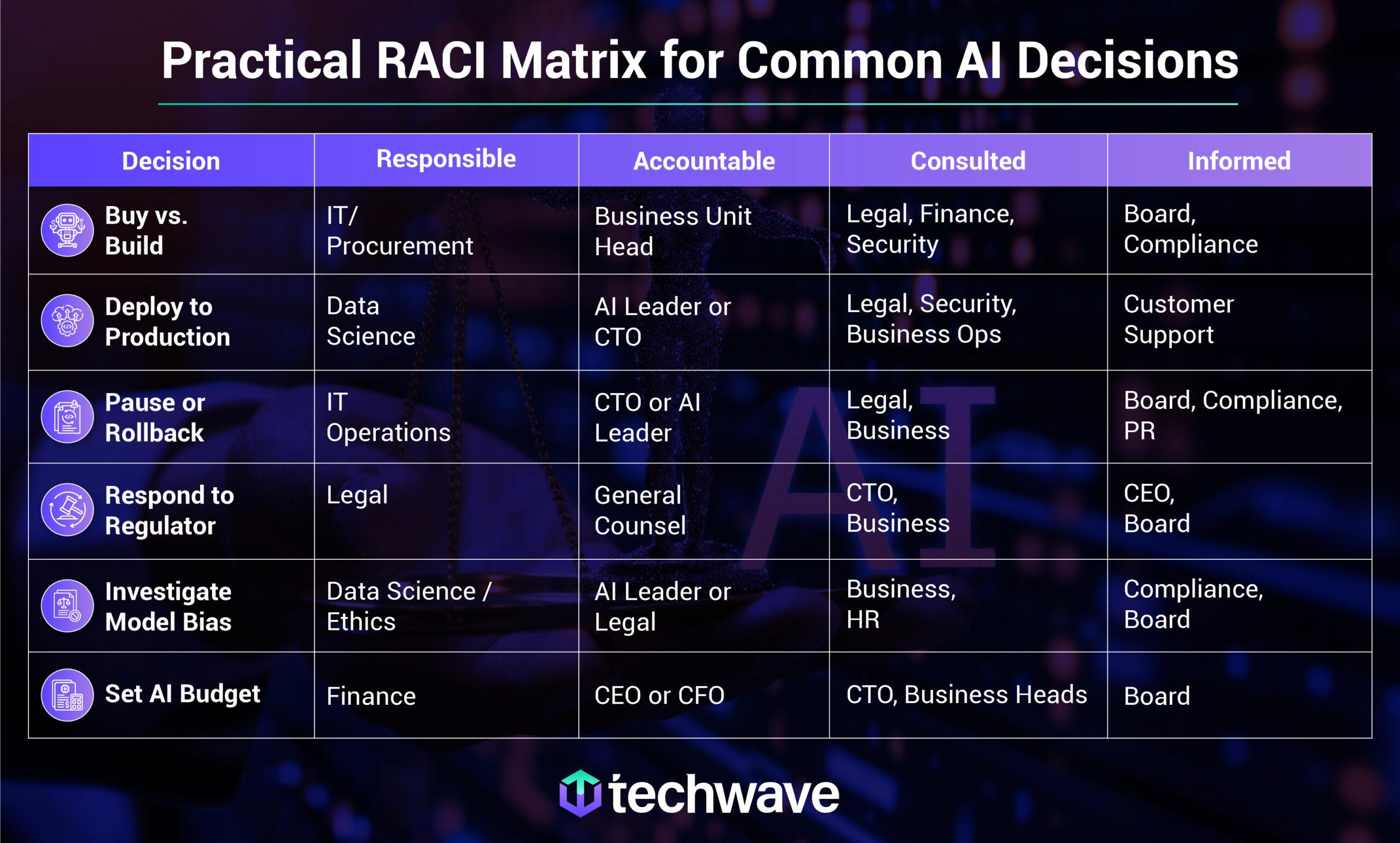
Triad is your architecture, while RACI is your decision protocol. You need both to move from ownership confusion to operational clarity.
How do you fix the AI ownership confusion?
Leaders see the symptoms every day but struggle to address them.
The top 9% of organizations that have moved beyond pilot stagnation offer a clue. Over 90% have dedicated AI leaders, but the title matters less than the accountability. They have aligned business, IT, and legal around a single operating model. Here is how you can do the same with three focused actions:
First, match decision rights to risk levels. Not every AI decision requires the same level of oversight. Map your use cases to low, medium, and high risk. Low-risk experiments need only a single product owner. High-risk deployments (customer-facing, regulated, or using sensitive data) require business, IT, and legal to sign off together.
Second, document who breaks ties. Disagreement between business, IT, and legal is normal. Paralysis happens when no one knows how to resolve it. Decide in advance who makes the final call when the three cannot agree. The CEO? An executive committee? Establish this before you need it.
Third, test your framework on one pilot. Pick a single AI initiative, such as a chatbot, a predictive model, or a marketing tool. Run it through your decision model. Who approves deployment? Who handles a regulator inquiry? Who initiates a rollback? If you cannot answer these questions for one pilot, you will not be able to answer them for a hundred.
Sort your AI ownership challenge with Techwave.
Techwave replaces ambiguous handoffs with documented decision rights. Through AI Strategy Consulting and FASTRACK AI, we map where your handoffs break and which risks fall between business, IT, and legal. Then we test your governance framework on a single, high-value AI use case before you scale.
Trace your AI handoffs and find the gaps.

Top 5 Questions Answered in This Blog
- Why do business, IT, and legal each claim ownership of AI decisions?
- What is the ownership illusion, and why is it dangerous?
- How does unclear ownership cause decision paralysis, shadow AI, and silent failures?
- What is the Triad Ownership Model, and how does it differ from RACI?
- How can enterprises start fixing ownership confusion today?
