


In this blog, you will find:
- Why the globalization era of cost-optimized supply chains and IT operations has reached its structural limit, and what “unpriced geopolitical risk” actually means for enterprise leaders.
- A clear distinction between sovereign cloud (data residency) and geopatriation (full operating model redesign across delivery, data, governance, apps, talent, and vendors).
- The regulatory drivers making geopatriation non-negotiable – DORA, NIS2, GDPR enforcement, and uncertainty around the transatlantic data framework.
- An honest assessment of whether third-party vendors can deliver geopatriated operations, including what no vendor currently sells and what building blocks to look for.
- Why geopatriation will not win on unit cost but wins on continuity, compliance, and risk reduction, and why that trade-off is now board-acceptable.
For roughly three decades, the dominant logic of global enterprise operations was elegantly simple: put your manufacturing where labor is cheapest, source your components from the most cost-efficient market, host your data wherever your hyperscaler offered the best price, and deploy talent wherever the arbitrage worked in your favor.
It was a compelling model until it wasn’t.
COVID-19 didn’t just disrupt supply chains. It revealed how much systemic risk enterprises had quietly accumulated in the name of cost optimization. Factory shutdowns across Asia paralyzed global manufacturing pipelines almost immediately. Enterprises that had optimized for just-in-time delivery discovered they had eliminated any meaningful buffer. Supply continuity took months and in some cases, years to rebuild.
The Ukraine war froze critical trade corridors overnight. Red Sea shipping attacks forced costly rerouting, raised insurance costs, compressed delivery windows across industries, and rattled global logistics networks. US-China tariff escalation put entire supply chain architectures in jeopardy.
And semiconductor shortages exposed a world-altering truth. The realization that advanced chip production was highly concentrated in a handful of facilities, primarily in Taiwan, triggered one of the most significant industrial policy responses in decades. The market had under-priced geopolitical concentration risk for a very long time.
Each event might have been absorbed individually. Together, they constituted a structural argument: the globalization model that treated cost efficiency as the primary variable had transferred risk to places enterprises hadn’t fully accounted for. Resilience didn’t just become a priority. It became the priority.
Boards have been evaluating resilience for some time as a core determinant of long-term enterprise value and continuity. That shift has a name now. Geopatriation, and by the end of this blog, you’ll know exactly what it demands of your operating model, and whether your current vendor partnerships are built to deliver it.
What geopatriation means and what it doesn’t.
Geopatriation refers to the deliberate realignment of enterprise operations, manufacturing, technology delivery, data management, talent models, and vendor partnerships around regional or jurisdictional frameworks rather than purely global cost logic. The driving force is resilience: the ability to maintain continuity, meet regulatory requirements, and sustain stakeholder trust even when global systems fracture.
This is not simply cloud repatriation or data localization, though both can be components of a geopatriation strategy. Geopatriation is relevant to every enterprise operating across borders. But it is most urgent (and already underway) in semiconductors, active pharmaceutical ingredients, defense supply chains, and financial data, where concentration risk has become unavoidable at the board level.
Sovereign cloud addresses one specific layer of data residency, operational control, and legal jurisdiction anchored within a country or region. AWS’s European Sovereign Cloud, designed to remain fully within EU legal jurisdiction, is a clear example. It’s a meaningful step, but not geopatriation in full.
Geopatriation is a much broader question about operating models. It touches how you build applications, where you anchor delivery capacity, which regulatory frameworks govern your workflows, and how your third-party vendors are structured to serve you across jurisdictions. Treating it as a cloud migration initiative undersells both the challenge and the strategic opportunity.
The real problem wasn’t globalization; it was unpriced risk.
Globalization wasn’t a mistake. It delivered genuine efficiency gains across manufacturing, technology, and talent for decades. The problem was subtler: enterprises optimized relentlessly for cost while leaving the associated geopolitical risk entirely off the balance sheet.
Dependency on a single trade corridor was treated as an acceptable assumption. Regulatory exposure from hosting sensitive data in a foreign jurisdiction was deferred as a compliance issue, not a strategic one. When compounding shocks arrived in overlapping waves, enterprises discovered that decades of cost optimization had quietly become decades of risk accumulation.
The lesson isn’t to abandon global operations. It’s to price the risk honestly and build operating models that can absorb geopolitical shocks without requiring a crisis response every time the world becomes less predictable. That realization is what’s driving geopatriation from a supply chain conversation to a board-level mandate.
Geopatriation will not win on unit cost. It wins on continuity, compliance, and risk reduction. That trade-off is now board-acceptable in a way it wasn’t five years ago. Boards no longer ask ‘Is this cheaper?’ They ask, ‘Can we afford not to do it?’
Geopatriation as an operating model, not a technology project
Geopatriation is not something your infrastructure team can implement in a sprint cycle. It’s a reconfiguration of how an enterprise delivers value across multiple jurisdictions simultaneously, with regulatory accountability in each one. That reconfiguration touches several interconnected dimensions.
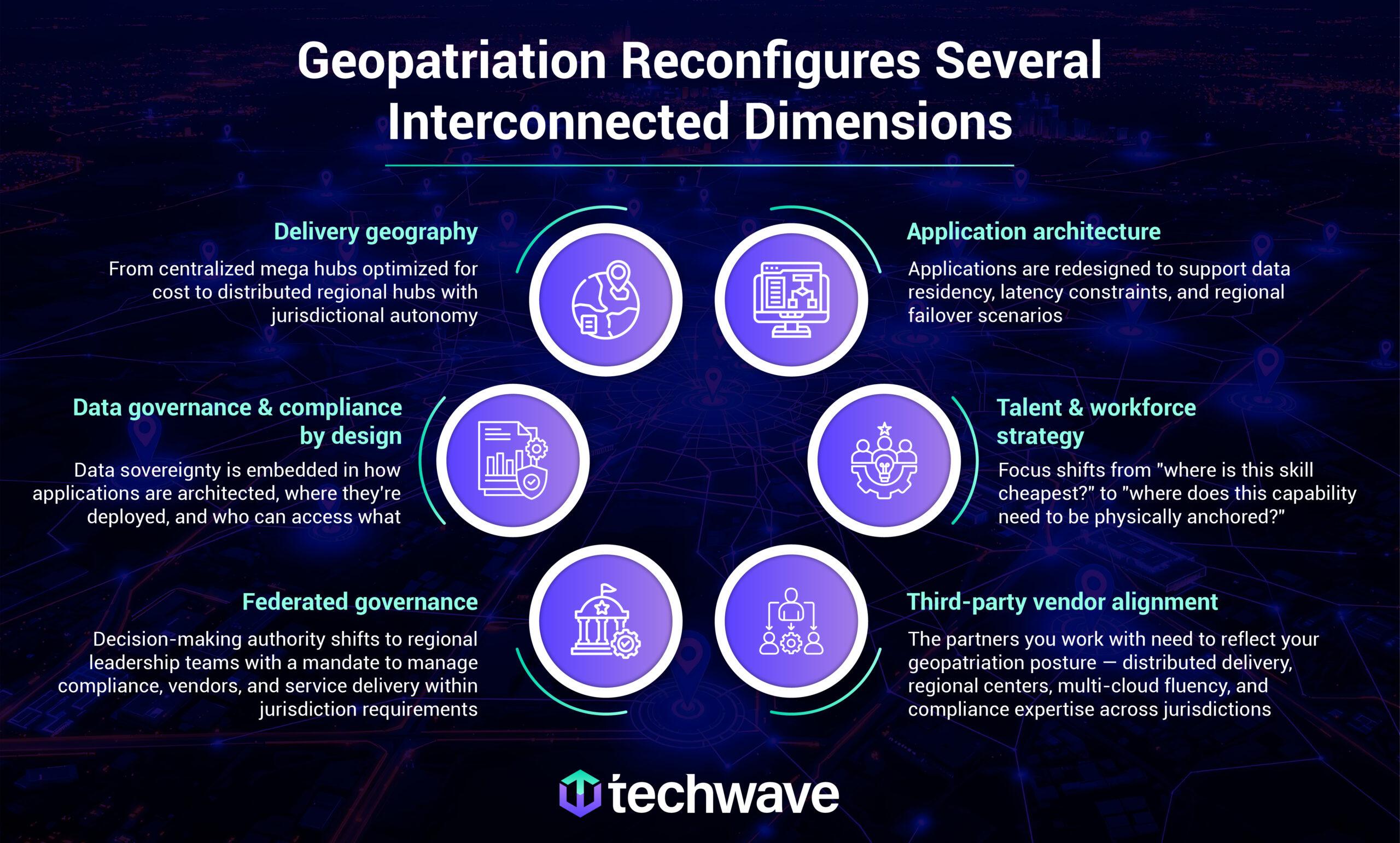
- Delivery geography: The shift is from centralized mega-hubs optimized for cost to distributed regional hubs that can operate with jurisdictional autonomy. This doesn’t mean dismantling global delivery; it means building resilience and regional alignment into the architecture.
- Data governance and compliance by design: In a geopatriated model, data sovereignty is embedded in how applications are architected, where they’re deployed, and who can access what. GDPR in Europe, DPDP in India (enacted in 2023), and analogous frameworks across the Middle East are simultaneously legal requirements and architecture requirements.
- Federated governance: Centralized command-and-control governance struggles in a geopatriated model. Decision-making authority needs to shift to regional leadership teams, with the mandate to manage compliance, vendor relationships, and service delivery in line with jurisdiction-specific requirements.
- Application architecture: Applications built for a single-cloud, globally distributed model may need to be redesigned to support data residency requirements, latency constraints, and regional failover scenarios. This is engineering work, not just infrastructure work.
- Talent and workforce strategy: The question is no longer only “where is this skill cheapest?” but also “where does this capability need to be physically anchored for regulatory, language, or proximity reasons?” That’s a fundamentally different conversation about workforce planning.
- Third-party vendor alignment: The partners you work with need to reflect your geopatriation posture. A vendor with genuinely distributed global delivery capacity, regional centers, multi-cloud fluency, and compliance expertise across jurisdictions is structurally better positioned than one operating from a single concentrated geography.
The compliance layer that makes geopatriation non-negotiable
Even if geopolitical tensions eased tomorrow, the regulatory pressure driving geopatriation wouldn’t.
Across Europe, GDPR, DORA, and NIS2 are independently mandating the same outcomes geopatriation delivers: jurisdictional control over data, operational resilience, and demonstrable governance of third-party technology providers.
DORA, in force since January 2025, requires financial entities to maintain Information and Communication Technology (ICT) risk management, tested failover, and third-party oversight that directly constrain where enterprise workloads can be hosted. NIS2 extends equivalent requirements across 18 sectors. GDPR enforcement reached a record €1.2 billion in fines in 2025 alone.
For CIOs and CISOs, the question shifts from “should we do this?” to “how do we execute it without fragmenting our operations in the process?”
Wondering how geopatriation maps to your current
compliance posture?
Let’s start that conversation
No one sells geopatriation off-the-shelf. Here’s what that means for your vendor strategy.
This question comes up early in most executive conversations on this topic, and the honest answer is: no vendor today sells a packaged geopatriation solution.
The concept is emerging too rapidly and spans too many operational dimensions for that. What capable vendors offer are building blocks, like cloud strategy and engineering, application development and modernization, data governance frameworks, compliance expertise, regional delivery capacity, and SAP enterprise capabilities. The strategic value lies in whether those building blocks can be assembled coherently around a geopatriation logic that aligns with your specific risk profile.
This is also why the conversation between enterprise leaders and technology partners needs to shift. The question isn’t “do you have a geopatriation service?” The productive question is: “Does your delivery model, geography, technical depth, and compliance track record allow you to help us operate resiliently across multiple jurisdictions, and can you reconfigure what you already have to serve that purpose?”
What Techwave brings to this conversation and why it’s already relevant.
Geopatriation isn’t a defined product category; it’s a strategic framework. While Techwave doesn’t offer a labeled solution, its existing capabilities closely align with the needs that geopatriation addresses.
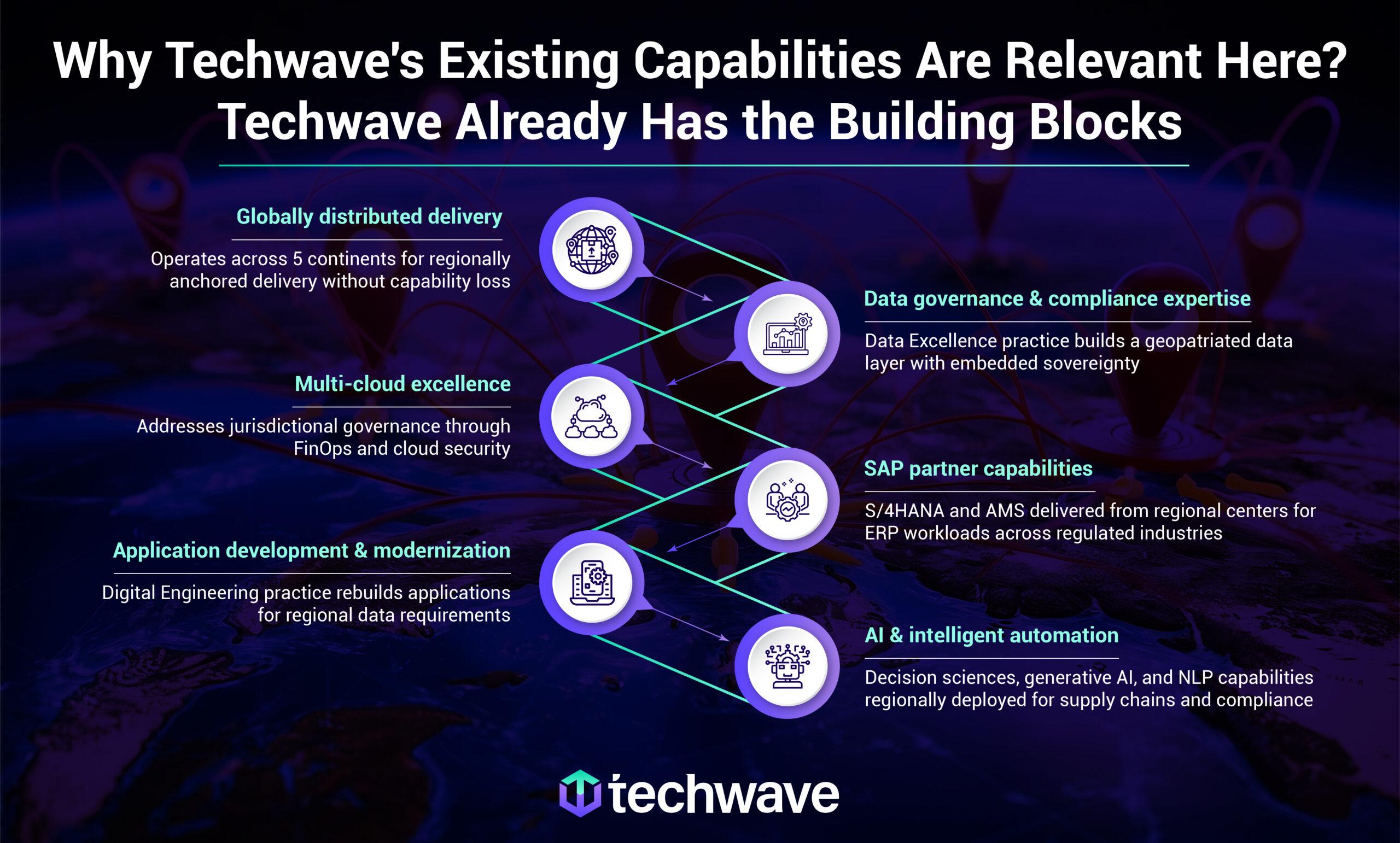
- Globally distributed delivery model: Techwave operates across 5 continents with a delivery capability structured for regional resilience. This is a prerequisite for supporting enterprises that need regionally anchored delivery without sacrificing capability depth. The delivery architecture isn’t a roadmap item; it already exists.
- Multi-cloud excellence practice: Supporting geopatriated operations means working fluently across cloud environments that differ by region. Techwave’s practice is not anchored to a single platform, and its FinOps and cloud security capabilities directly address jurisdictional governance requirements.
- Application development and modernization: Adapting or rebuilding applications for a world of regional data requirements and distributed deployment is exactly what Techwave’s Digital Engineering service delivers.
- Data governance and compliance expertise: Techwave’s Data Excellence service, spanning data engineering, lakehouse architectures, and AI-enabled analytics, is directly applicable to building a geopatriated data layer where sovereignty is embedded in the architecture rather than bolted on afterward.
- SAP capabilities across regulated industries: For enterprises running complex ERP environments, and particularly those running SAP, geopatriation often involves rethinking how SAP workloads are deployed across markets with differing compliance requirements. Techwave has navigated across financial services, manufacturing, life sciences, and utilities.
- AI & automation expertise: Techwave’s AI and intelligent automation capabilities, such as decision sciences, generative AI, computer vision, and Natural Language Processing (NLP), can be customized for regional deployment, enabling supply chain optimization, automated compliance monitoring, and data sovereignty without crossing jurisdictional boundaries.
Techwave doesn’t need to build new capabilities for geopatriation. The work is reconfiguring what already exists around the specific resilience logic of a given enterprise.
Is your operating model ready? Here’s where to start.
If your board is asking about operational resilience in ways that feel structurally different from two or three years ago, geopatriation is likely already embedded in that conversation, even if no one is using that term yet.
Start with an honest assessment: where does your operating model carry geopolitical and jurisdictional risk in your supply chain, data architecture, application landscape, or vendor relationships? From there, a phased reconfiguration toward regional resilience is achievable without dismantling what works.
That’s a conversation Techwave is equipped to have, not because there’s a pre-packaged answer waiting, but because global delivery capacity, technical breadth, and regulatory experience across industries create a credible starting point for the actual complexity ahead.
Start the geopatriation conversation with Techwave

Top 5 Questions Answered in This Blog
- What is geopatriation, and how is it different from sovereign cloud or data localization?
- Where did the globalization model come up short?
- Can third-party vendors actually deliver geopatriated operations, or is this only for in-house teams?
- Which regulatory drivers are making geopatriation non-negotiable?
- Does geopatriation increase cost, and if so, why are boards accepting that trade-off now?
