

In this blog, you will find:
- Why enterprise AI has a context problem that goes beyond the model itself.
- How SAP Business Data Cloud preserves business semantics with governed data products.
- The role of Databricks Unity Catalog in synchronizing SAP metadata for discoverability.
- Two credible architecture models: SAP-led vs. enterprise Databricks with SAP Connect.
- Why preserving meaning, lineage, and policy matters more than just moving data.
How Databricks and SAP help leaders build trusted, business-aware data and AI capabilities
In many of my conversations with CXOs, one challenge comes up repeatedly: their organisations have invested substantially in cloud platforms, modern data estates and artificial intelligence. They have more data and more sophisticated technology than ever before. Yet confidence in using AI for consequential business decisions has not advanced at the same pace.
The issue is rarely the model alone. It is whether the model understands what the data means within the business: how a delayed order affects revenue, why a maintenance event carries operational risk, when an invoice requires intervention, or how a supplier disruption will influence production.
Enterprise AI has a context problem. This is why the collaboration between Databricks and SAP warrants serious attention. Its relevance extends beyond the integration of two technology platforms. It begins to address a long-standing separation between the systems in which business meaning is created and the platforms on which data intelligence is developed.
Business context is becoming part of the data architecture
Organisations have traditionally moved SAP data into external platforms through extracts, replicated tables and custom pipelines. Although the data could be made available for reporting and analytics, much of its business meaning often had to be reconstructed outside SAP. Anyone who has worked with SAP data understands the challenge. A table or field is not inherently meaningful because it has been extracted successfully. Its meaning comes from the business process around it: organisational hierarchies, financial structures, master-data relationships, transaction states, policy definitions and process dependencies.
Data engineers have frequently had to recover this context through technical documentation, custom mappings and the experience of SAP specialists. This increases delivery effort and creates the risk that different teams will interpret the same business information differently.
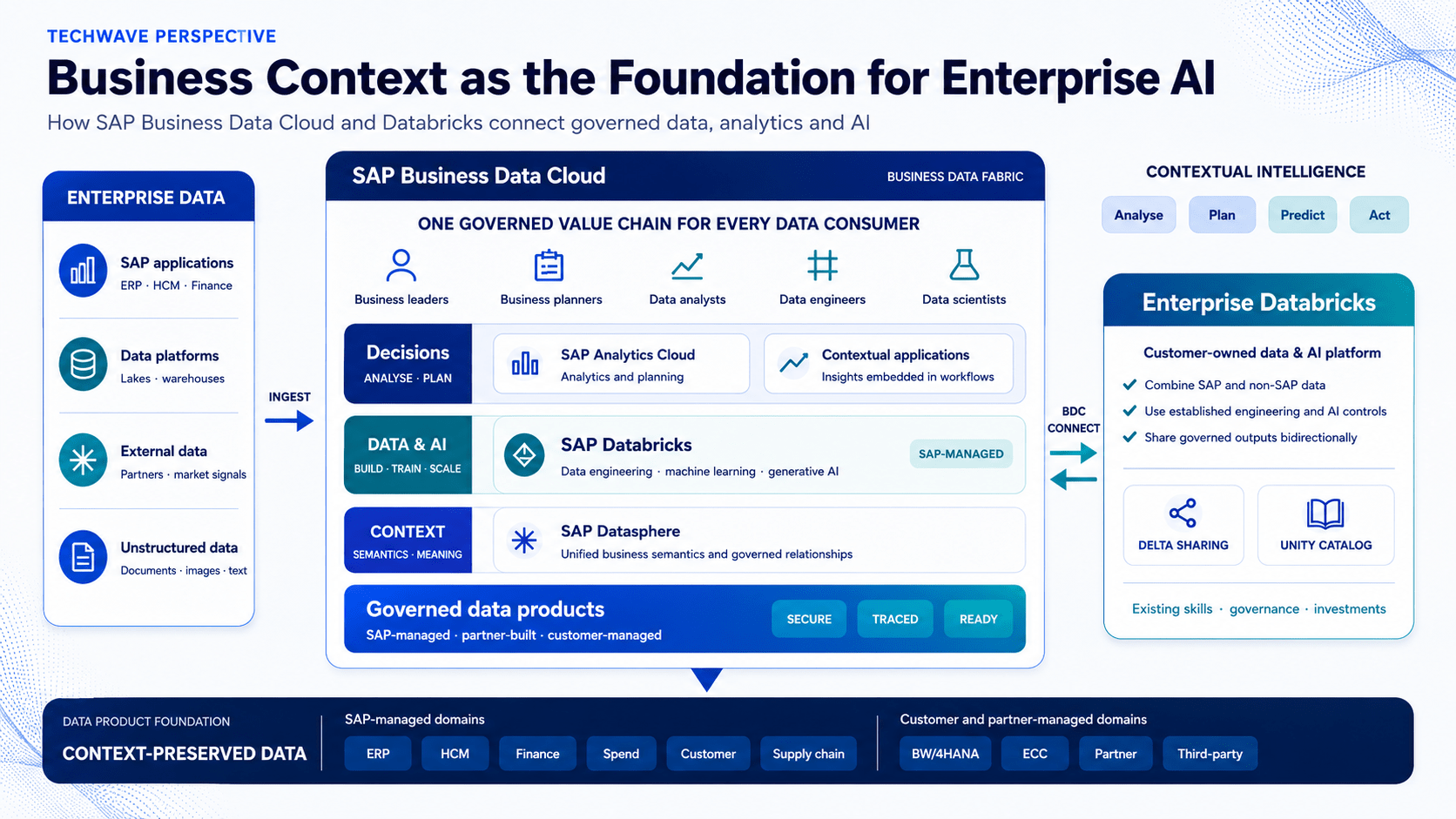
SAP Business Data Cloud introduces a more structured approach by making governed SAP data products available with their business semantics intact. SAP Databricks, the SAP-managed Databricks service embedded within Business Data Cloud, then provides the engineering, analytics, machine learning and AI capabilities required to work with those data products.
For organisations that already have an established Databricks environment, SAP Business Data Cloud Connect provides a complementary route. It enables live, bidirectional, zero-copy sharing between SAP Business Data Cloud and Databricks through Delta Sharing.
The important development is not simply that SAP data can be accessed from Databricks. It is that the data can be shared as a governed product carrying substantially more of its original business context.
From Moving Data to Preserving Meaning
The introduction of automatic SAP semantic metadata synchronisation into Databricks Unity Catalog in 2026 represents an important progression in this partnership.
For mounted SAP Business Data Cloud shares, metadata such as table and column descriptions, primary-key relationships, supported foreign-key relationships and SAP personal-data governance tags can be synchronised into Unity Catalog. SAP Business Data Cloud remains the source of truth for this metadata.
For data practitioners, this makes SAP information more understandable and discoverable. For governance teams, it supports more consistent classification and access policies. For AI systems, it provides a stronger foundation for interpreting business entities and the relationships between them.
The previous generation of enterprise integration focused on moving data. The emerging requirement is to preserve meaning, lineage and policy.
However, technology leaders should be precise about what this does and does not solve. Zero-copy sharing can reduce unnecessary replication between SAP Business Data Cloud and Databricks. It does not remove the need for data quality management, master-data alignment, security design, model governance, cost controls or accountability for business outcomes.
Similarly, semantic metadata gives AI systems more context, but it does not automatically make every dataset reliable or every model suitable for operational use. Organisations still need to determine which data products are authoritative, how business definitions are governed and where human oversight must remain.
Let the operating model guide the architecture
A question I expect many technology leaders to consider is whether Databricks should operate within the SAP-managed environment or as the organisation’s broader enterprise data and AI platform.
Both models are credible.
An SAP-led Data and AI Architecture
For an organisation whose data strategy is centred largely on SAP, the native SAP Databricks service within Business Data Cloud can provide a coherent route. SAP Business Data Cloud remains the governed business-data foundation, while SAP Databricks supports advanced engineering, data science and AI workloads.
This model may be appropriate where SAP data products are the primary semantic and governance anchor, and where the organisation prefers an integrated SAP-managed service.
An Enterprise Databricks Architecture Connected to SAP
A second model applies to organisations that have already established Databricks as their enterprise data and AI platform. In this case, SAP Business Data Cloud Connect can make governed SAP data products available within the existing Databricks environment, where they can be combined with information from CRM platforms, industrial systems, IoT environments, documents and external sources.
Here, SAP continues to perform its role as a critical transactional environment. SAP Business Data Cloud preserves and exposes the relevant business context, while Databricks supports cross-enterprise data engineering and intelligence.
Let the operating model guide the architecture
Choosing between SAP Databricks within Business Data Cloud and an enterprise Databricks environment is not a binary decision about remaining within or moving away from SAP. It is an operating-model decision.
Leaders should determine where responsibility for data governance and AI delivery will reside, which business domains require SAP and non-SAP data to be combined, and how intelligence will be incorporated into operational workflows. These considerations should guide the architecture.
Value is created within the business process
Context-rich SAP data becomes more valuable when combined with operational, external and unstructured information. This can support decisions across asset maintenance, working capital, supply-chain risk and customer operations.
Success should be measured by whether the resulting intelligence is governed, acted upon and evaluated within the relevant business process.
Leadership teams should therefore focus on three priorities:
- Start with a bounded, measurable business decision.
- Preserve semantics, quality and governance across both platforms.
- Design operational adoption from the outset and expand after value has been demonstrated.
The Strategic Implication
SAP and Databricks allow organisations to connect SAP’s process knowledge and governed data products with cross-enterprise data engineering and AI capabilities. Their combined value lies in creating trusted intelligence that can inform decisions, operate within defined controls and become part of how the organisation runs.


Top 5 Questions Answered in This Blog
- Why does enterprise AI struggle with business context?
- How does SAP Business Data Cloud preserve business meaning in data products?
- What is the role of Databricks Unity Catalog in SAP data sharing?
- What are the two architecture models for Databricks and SAP integration?
- How should leaders choose between the two integration models?
