

In this blog, you will find:
- Why modern IT environments create a dangerous signal-to-noise problem that leads to costly downtime.
- What AIOps actually does and how it shifts operations from reactive firefighting to predictive management.
- How CXOs are using AIOps as a structural cost driver, not just a technical fix.
- How Techwave’s Nalora platform operationalizes AIOps across complex IT environments.
- What a real-world AIOps implementation looks like, and the outcomes it delivers.
Digital services are no longer just a component of the business; they are the revenue engine itself. When this engine stalls, the financial impact is immediate and severe.
According to recent research on enterprise outage impact, the average cost of IT downtime has escalated to $9,000 per minute.
For leadership, ensuring the reliability of these systems has shifted from a technical preference to a strategic mandate for economic resilience. AIOps functions as a modern insurance policy against these escalating risks.
The High Cost of the “Visibility Gap”
Today, cloud-native and distributed systems have created massive interdependencies that manual investigation simply cannot map accurately or quickly enough.
Modern IT systems now generate thousands of alerts daily. A significant proportion of these are false positives or duplicates, creating a dangerous “signal-to-noise” problem that, as industry analysts have consistently flagged, is one of the defining operational challenges of the cloud era.
When critical issues are buried under this noise, delays and downtime become inevitable. This isn’t just a technical glitch; it’s a financial leak where $9,000 vanishes every 60 seconds.
Bridging the Intelligence Gap in Operations
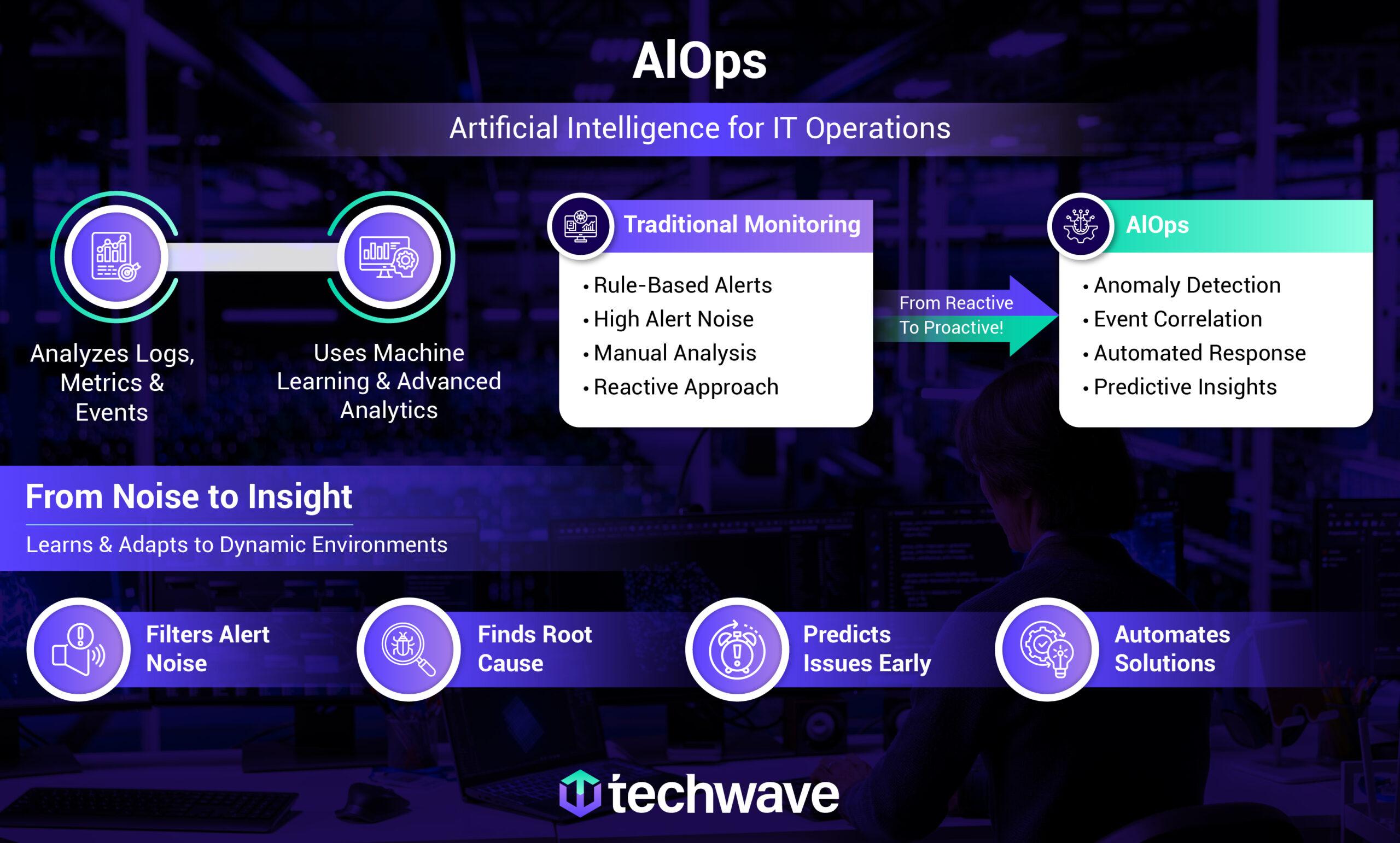
AIOps, or Artificial Intelligence for IT Operations, represents the strategic layer of intelligence required to manage modern complexity. It uses machine learning to filter noise, detect anomalies, and correlate events across fragmented toolsets.
It shifts operations from reactive troubleshooting to proactive and predictive management.
By providing better visibility into complex environments, it allows IT to function as a business enabler rather than a cost center.
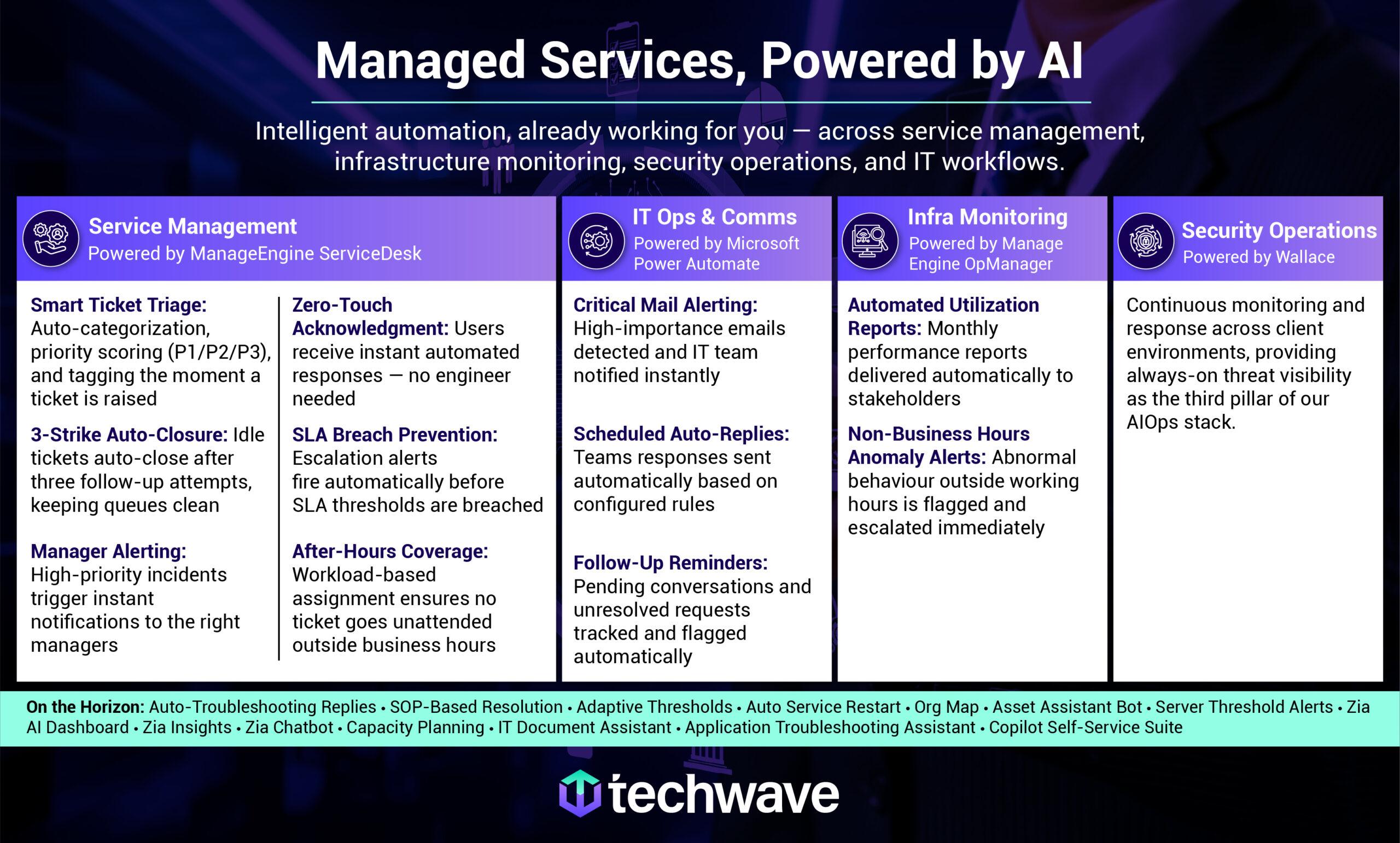
At Techwave, this intelligence layer is operationalized through Nalora – our enterprise AI Fabric that aligns intelligence with intent across systems, data, and operations.
Nalora unifies fragmented signals across the IT landscape, enabling AIOps capabilities such as anomaly detection, event correlation, and autonomous remediation to work seamlessly across environments.
Learn more: Explore our Cloud & AIOps Services →
Why CXOs View AIOps as a Strategic Cost Driver
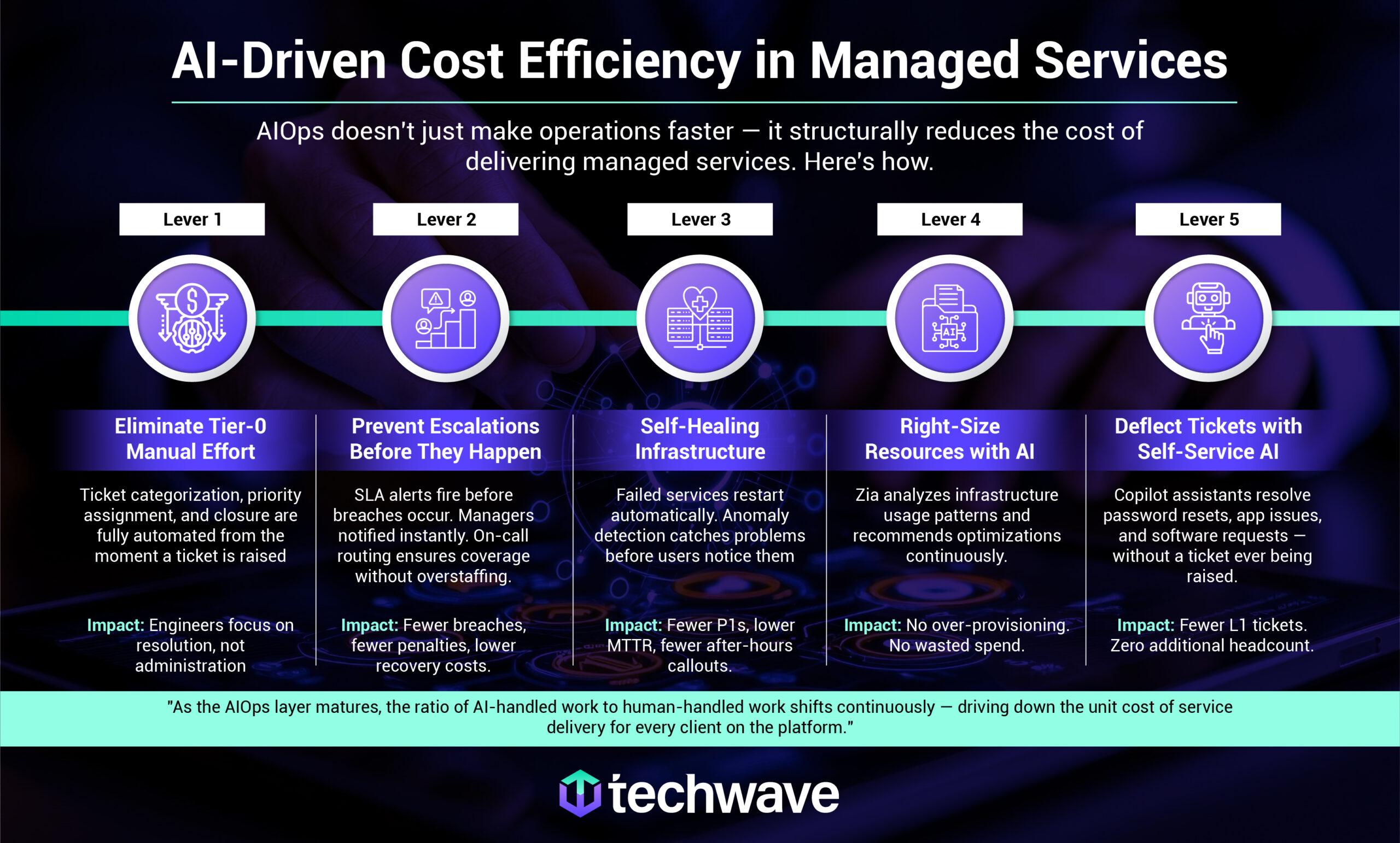
For a CXO, AIOps isn’t just about “fixing bugs” — it’s about structural cost optimization. In an era of tightening budgets, AIOps provides a way to scale operations without a linear growth in headcount.
Reclaiming High-Value Engineering Talent
AIOps automates the Tier-0 and Tier-1 triage layers. By dramatically reducing alert volume, leadership can redirect their best engineers toward innovation and revenue-generating projects instead of repetitive firefighting.
This mirrors a broader trend that leading global research on AI adoption consistently highlights – organizations deploying AI to automate routine operations are freeing human capital for strategic work at a measurable scale.
Related: How to Reduce Cloud Costs and Improve Efficiency
Reducing the Operational Workforce Burden
Maintaining 24/7 uptime traditionally meant hiring extensive night shifts and on-call rotations. Because AIOps systems run autonomously around the clock, they can identify and remediate standard issues without human intervention.
This reduces the total number of operations staff needed for routine maintenance. It also mitigates the risk of human error, which remains a leading cause of outages during high-stress recovery windows.
Predictive Uptime as Insurance
More than half of all outages are preceded by subtle warning signals that go unnoticed by human operators. AIOps detects these patterns – such as a slow creep in memory usage or a minor latency spike in a specific microservice.
By addressing these failure points before they manifest as an outage, the organization effectively “ensures” its uptime, preventing the catastrophic financial losses associated with a total service collapse.
Recommended Article: The Smart Way to SAVE up to 60% on Off-Hours IT Support (with DX Nightwatch: Turnkey Off Hours Support)
What This Looks Like in Practice
When implemented correctly, AIOps moves an organization from a state of constant crisis to one of predictable stability. The following example demonstrates how this intelligence layer solves distinct business challenges.
- Problem: A global enterprise suffered from extreme alert fatigue, where a significant share of critical signals was ignored due to sheer volume and noise.
- Intervention: Techwave integrated an intelligent operations layer to automate ticket triage and correlate events across the infrastructure, achieving 24/7 NOC coverage with structured SLA-driven response.
- Outcome: The organization achieved 99.9%+ system availability, measurably improved MTTA and SLA adherence, and shifted IT operations from reactive firefighting to fully managed, proactive delivery.
Conclusion: The Move Toward Autonomous IT
As IT environments grow more complex, the traditional “reactive” models are becoming exhausted. AIOps is the foundation for the future of autonomous IT operations.
In this future, systems will not only monitor for problems but will also initiate recovery actions independently. This evolution allows human teams to shift their focus toward governance, optimization, and long-term strategy.
The gap between fragmented monitoring and a strategic AIOps capability is where business resilience is either won or lost. Leaders who invest in these intelligent platforms today are securing their company’s future against the inevitable complexities of tomorrow.
Ready to explore what intelligent IT operations looks like for your organization? Talk to our team today!

Top 3 Questions Answered in This Blog
- Why does IT downtime cost so much, and what is causing organizations to lose control of their alerts?
- How does AIOps help CXOs reduce operational costs without scaling headcount?
- What does a successful AIOps implementation actually look like in practice?
